CRDT Socket Sync







Overview
CRDT Socket Sync provides a robust, real-time synchronization system that allows multiple clients to collaborate on shared documents without conflicts. Built on top of crdt_lf, this package enables seamless data synchronization with automatic conflict resolution.
Features
- 🔄 Real-time Synchronization: Instant propagation of changes across all connected clients
- 🌐 WebSocket Support: Built-in WebSocket client and server implementations
- 🔧 Conflict Resolution: Automatic conflict-free merge of concurrent operations
- 📦 Compression: Optional data compression for efficient network usage
- 🔌 Modular Architecture: Separate client and server components with clean abstractions
- 📡 Automatic Reconnection: Robust connection handling with automatic retry logic
- 💓 Liveness Detection: Ping/pong tracking detects half-open connections and reconnects
- 🚰 Backpressure: Bounded per-connection send queue drops peers that cannot keep up (they re-sync on reconnect)
- 🗜️ History Pruning: Server takes a snapshot and prunes confirmed history once every client aligns on a common frontier
- 🎯 Type Safety: Full Dart type safety with generic document handlers
- 📊 Event Monitoring: Comprehensive event streams for connection and synchronization monitoring
- 🔌 Plugins: Extendable plugin system for custom functionality
- 📮 Relay Mode: An alternative sync model where the server is a CRDT-agnostic relay — it persists and rebroadcasts opaque change blobs while merging happens entirely on the clients (details)
Built-in Plugins
- 📡 Awareness Plugin: Track the awareness of the clients.
Installation
Add this package to your pubspec.yaml:
dependencies:
  crdt_socket_sync:
  crdt_lf:
Then run:
dart pub get
Communication modes
The package ships two independent synchronization models. Pick one per deployment — the wire format, type-code convention and the plugin system are shared, but the server responsibilities are very different:
- Server–Client mode (CRDT-aware) — the
server holds the documents, applies incoming changes, computes deltas and
prunes confirmed history. Use it when you want a single authoritative backend
that understands
crdt_lf. - Relay mode — the server is dumb: it persists and
rebroadcasts opaque change blobs per room and never parses CRDT data; merging
happens entirely on the clients. Use it for cheap horizontal rooms, easy
porting to other runtimes (including serverless), and to keep the backend free
of
crdt_lf.
Cross-cutting concerns (plugins, compression, wire format, connection status) are documented once under Shared topics.
Server–Client mode (CRDT-aware)
In this mode the server owns the documents through a
CRDTServerRegistry: it validates handshakes with version
vectors, applies incoming changes, broadcasts them to the other clients, and
takes snapshots to prune confirmed history.
Quick Start
Server Setup
import 'dart:io';
import 'package:crdt_socket_sync/web_socket_server.dart';

void main() async {
  // Create a server registry to manage documents
  final registry = InMemoryCRDTServerRegistry();

  // Create and start the WebSocket server
  final server = WebSocketServer(
    serverFactory: () => HttpServer.bind('localhost', 8080),
    serverRegistry: registry,
  );

  await server.start();
  print('Server started on localhost:8080');

  // Listen to server events
  server.serverEvents.listen((event) {
    print('Server event: ${event.type} - ${event.message}');
  });
}
Client Setup
import 'package:crdt_socket_sync/web_socket_client.dart';
import 'package:crdt_lf/crdt_lf.dart';

void main() async {
  // Create a CRDT document
  final document = CRDTDocument(peerId: PeerId.generate());

  // Register handlers for different data types
  final listHandler = CRDTListHandler<String>(document, 'shared_list');

  // Create the client
  final client = WebSocketClient(
    url: 'ws://localhost:8080',
    document: document,
    author: document.peerId,
  );

  // Monitor connection status
  client.connectionStatus.listen((status) {
    print('Connection status: $status');
  });

  // Connect to server
  final connected = await client.connect();
  if (connected) {
    print('Connected successfully!');

    // Make changes to the document
    listHandler.insert(0, 'Hello, World!');
  }
}
How it works
Connection & Handshake Phase
Real-time Updates
Out-of-sync Recovery
Server Registry
The server stores documents through a CRDTServerRegistry. Two come with the
package: InMemoryCRDTServerRegistry, which keeps everything in memory, and
PersistentServerRegistry, which keeps every
document on disk through any crdt_lf storage adapter. Implement the interface
yourself only if neither fits.
The interface is fully asynchronous:
class CustomServerRegistry implements CRDTServerRegistry {
final Map<String, CRDTDocument> _documents = {};
Future<void> addDocument(String documentId, {PeerId? author}) async {
_documents[documentId] = CRDTDocument(
peerId: author ?? PeerId.generate(),
documentId: documentId,
);
}
Future<CRDTDocument?> getDocument(String documentId) async =>
_documents[documentId];
Future<bool> hasDocument(String documentId) async =>
_documents.containsKey(documentId);
Future<Set<String>> get documentIds async => _documents.keys.toSet();
// ... removeDocument, documentCount, createSnapshot, getLatestSnapshot,
// applyChange (see the CRDTServerRegistry interface for the full list).
}
applyChangeMUST letCausallyNotReadyExceptionpropagate: the server relies on it to detect an out-of-sync client and trigger a re-sync. Swallowing it would silently drop the change.
Persisting changes & snapshots
InMemoryCRDTServerRegistry is not durable — documents are lost on restart.
You do not have to write the durable one yourself: PersistentServerRegistry
is a CRDTServerRegistry that keeps every document it serves on disk, on any
adapter.
final registry = PersistentServerRegistry(
  backend: await CRDTHive.open(),
  // Snapshot a document once its log passes this many changes.
  compactAfter: 500,
);
That is the whole setup. backend is a
CRDTStorageBackend — an
adapter's CRDTHive.open(), CRDTDrift.open() or CRDTSqlite.open() — and it is where the
documents, their snapshots and the identity the server writes them under all
live.
It holds the live documents and routes to them, the way any registry does. It
never reads or writes storage by hand. Each document gets a
CRDTDocumentPersistence, which
follows CRDTDocument.events and writes down what each event reports. So:
- a change applied through
applyChangeis batched with the ones around it instead of costing one write each, - a snapshot replaces the one before it, and the prune that follows drops exactly the changes it covered — both inside one transaction where the backend has one,
- documents open lazily, so a document costs nothing until something asks for it.
writeDelay is how long a change waits for the ones after it. It leaves a
window where a change is acknowledged but not yet on disk, and that is safe: a
client reconciles at the next handshake and re-sends whatever the server no
longer has. Pass Duration.zero to make the window as small as it gets.
That window is also why a shutdown has to close the registry: what is still
waiting has to be written before the process ends. WebSocketServer.dispose
does it for you. Closing the registry by hand is only for a server that owns
one without a WebSocketServer around it:
await registry.close();
The registry refuses to open anything after that.
Getting a document back out of memory
Opening lazily is one half. A document stays in memory once it has been asked for, so a server that never lets go holds every room it has ever served.
// When the last client of a room disconnects.
await registry.releaseDocument(roomId);
releaseDocument writes what the document is holding, closes it, and leaves the
id in the catalog: the room is still served, it is just not in memory, and the
next getDocument reads it back from the storage. That is what separates it
from removeDocument, which drops the room from the catalog — and with the
default catalog, deletes it.
idleAfter does the same on a timer, for a server with no natural place to
call releaseDocument:
final registry = PersistentServerRegistry(
  backend: await CRDTHive.open(),
  idleAfter: const Duration(minutes: 10),
);
One rule either way: the document must not be in use. Releasing disposes it,
and a caller still holding what an earlier getDocument handed back would be
writing into a disposed document. Every session in this package re-reads through
getDocument, so releasing between two requests is safe — which is why
idleAfter should be far longer than a request takes.
Pick your backend — the registry only ever sees the CRDTStorageBackend
interface:
- crdt_lf_hive — Hive-backed storage
- crdt_lf_drift — Drift (SQL) storage
- crdt_lf_sqlite —
sqlite3storage
The list of documents
documentIds, hasDocument and documentCount come from a
ServerDocumentCatalog. You do not have to write one: the default is
BackendDocumentCatalog, which asks the backend, because a CRDTStorageBackend
already lists the documents it holds. The server keeps no second list that can
drift from the first, and it finds its documents again after a restart with
nothing to configure.
One consequence to know: with that catalog, removeDocument deletes the
document — its changes, its snapshots and its identity. Forgetting a document
without deleting it is not something the backend can express, and
releaseDocument is what you want to get one out of memory.
Pass InMemoryServerDocumentCatalog for a server that should start empty every
time and fill up as clients name their documents, or write your own three
methods over whatever list you already keep:
abstract interface class ServerDocumentCatalog {
  Future<Set<String>> get documentIds;
  Future<void> add(String documentId);
  Future<void> remove(String documentId);
}
Broadcasting a compaction
A snapshot comes with a prune, so the history it covers leaves the server. A
client still replaying that history has to be given the snapshot instead. The
snapshots stream reports each one as it is taken:
registry.snapshots.listen((event) async {
  final document = (await registry.getDocument(event.documentId))!;
  await server.broadcastMessage(
    SyncMessage.documentStatus(
      documentId: event.documentId,
      snapshot: event.snapshot,
      changes: document.exportChanges(),
      versionVector: document.getVersionVector(),
    ),
  );
});
The example server puts all of this together:
registry.dart.
The relay mode does not use any of this. A
RelayStorekeeps opaque blobs the relay never decodes, keyed by a per-room sequence number, so it is deliberately not built oncrdt_lf_persistence— a relay does not have to be written in Dart, let alone know what a CRDT is. On the relay client side persistence is the app's own document: open it beforeconnect(), and the welcome reconciliation pushes whatever the relay is missing.
Server Events
Monitor detailed synchronization events on the server:
server.serverEvents.listen((event) {
  switch (event.type) {
    case ServerEventType.clientConnected:
      print('Client ${event.data?['clientId']} connected');
      break;
    case ServerEventType.clientDisconnected:
      print('Client ${event.data?['clientId']} disconnected');
      break;
    case ServerEventType.clientChangeApplied:
      print('Change applied from client');
      break;
    // clientHandshake, clientDocumentStatusCreated, clientOutOfSync,
    // messageBroadcasted, messageSent, snapshotCreated, error, ...
  }
});
Imports
// Basic client interfaces
import 'package:crdt_socket_sync/client.dart';

// WebSocket client implementation
import 'package:crdt_socket_sync/web_socket_client.dart';

// Basic server interfaces
import 'package:crdt_socket_sync/server.dart';

// WebSocket server implementation
import 'package:crdt_socket_sync/web_socket_server.dart';
Relay Mode
The package ships a second, independent sync model next to the CRDT-aware server described above: relay mode. Here the server is a dumb relay — it persists and rebroadcasts opaque change blobs per room and never interprets CRDT data; merging happens entirely on the clients. The room is identified by the document id: one relay server hosts many rooms.
When to use it
The only fundamental difference between the two modes is where the CRDT logic lives:
- Server–Client (CRDT-aware) — the server understands
crdt_lf: it applies and merges changes and computes the deltas each client needs. - Relay — all the CRDT logic runs on the clients; the server only stores the changes opaquely and rebroadcasts them, never parsing CRDT data.
Everything else (delivery guarantees, reconnect policy, initial sync) follows
from that choice. Pick relay when you want a CRDT-agnostic backend (no
crdt_lf on the server, easy to port to other runtimes); pick server–client
when a single authoritative backend should understand and merge the documents.
Relay Quick Start
// Server
import 'dart:io';
import 'package:crdt_socket_sync/web_socket_relay_server.dart';

void main() async {
  final server = WebSocketRelayServer(
    serverFactory: () => HttpServer.bind('localhost', 8080),
    // store: defaults to InMemoryRelayStore()
  );
  await server.start();
}
// Client
import 'package:crdt_lf/crdt_lf.dart';
import 'package:crdt_socket_sync/web_socket_relay_client.dart';

void main() async {
  final document = CRDTDocument(
    peerId: PeerId.generate(),
    documentId: 'my-room',
  );
  final text = CRDTFugueTextHandler(document, 'content');

  final client = WebSocketRelayClient(
    url: 'ws://localhost:8080',
    document: document,
    author: document.peerId,
  );

  await client.connect();
  text.insert(0, 'Hello, relay!'); // queued, pushed, acked, rebroadcast
}
Local edits are delivered at-least-once: a change leaves the client
queue only when the relay acknowledges it, and unacked changes survive
reconnects (re-delivery is harmless because peers de-duplicate imported
changes). Persistence is pluggable through the RelayStore interface
(InMemoryRelayStore by default).
Join & Welcome
Push, Ack & Rebroadcast
Surviving a restart
A welcome carries the whole room: the snapshot, plus the log after it. So the client knows exactly what the relay holds, and pushes whatever the document holds beyond that — whoever wrote it.
That is all an offline-first client needs. Persist the document with
crdt_lf_persistence, and open
the persistence before you connect:
final document = CRDTDocument(documentId: roomId);
final persistence = await CRDTDocumentPersistence.open(document, storage);

// Only now: the restored document is what the welcome is reconciled against.
await client.connect();
The text written on a plane is read back on the next launch, and reaches everyone else at the next welcome. There is no outbox for your app to keep.
Two things follow from the same rule. A change of another peer that the relay lost is pushed again by whoever still holds it, so a room heals itself. And a version vector cannot describe a hole in the middle of one peer's sequence, only how far that peer got — the same limit the server-client mode has.
Re-delivering a change the relay already had is harmless: the relay appends it and every peer discards it as known.
Log Compaction
The room log grows with every push. Past a threshold
(RelayProtocol.logCompactThreshold), the relay sets compact: true on an
ack or welcome, asking that one client (rate-limited per room) to upload
a snapshot. The relay stores the snapshot and deletes the covered log
entries; late joiners then bootstrap from snapshot plus residual log.
The client caps upToSeq at the highest contiguous sequence it has
imported, so a snapshot can never silently drop a concurrent change that the
relay logged but this client has not received yet.
Client seq window
The relay stamps every change blob with a monotonic seq. Each client keeps a
window over the room log: maxContiguous — the highest seq S such that it has
imported every entry in [1, S] — plus any detached ranges above it, the
holes left when concurrent clients' rebroadcasts arrive out of order. Three
inbound frames feed the window — a welcome (the whole prefix), an ack of
your own push, and rebroadcast changes — and whenever a hole fills, the
contiguous frontier advances.
maxContiguous is the only thing that bounds a snapshot upload: a compaction
request is capped at it, so the client can never claim to cover a seq it has not
imported (which would let the relay delete a change no snapshot holds). The seq
window is pure relay bookkeeping — it does not decide what the document
shows; that is the CRDT's own causal job (importChanges applies the
causally-ready subset and skips the rest).
Relay Plugins & Awareness
The relay client and server are regular CRDTSocketClient /
CRDTSocketServer implementations, so the plugin system works
unchanged — including the awareness plugin, since presence
only needs sessions and broadcasting, never CRDT parsing:
final server = WebSocketRelayServer(
  serverFactory: () => HttpServer.bind('localhost', 8080),
  plugins: [ServerAwarenessPlugin()],
);

final client = WebSocketRelayClient(
  url: 'ws://localhost:8080',
  document: document,
  author: document.peerId,
  plugins: [ClientAwarenessPlugin()],
);
Awareness state is ephemeral: it is rebroadcast to the room but never
persisted in the RelayStore.
Implementing a relay server
WebSocketRelayServer is only one implementation of the relay contract.
Because the server never parses CRDT data, the relay side is just a JSON
message contract over a WebSocket and can be implemented on any runtime —
including serverless hosts such as Cloudflare Workers + Durable Objects.
The greyhound_markdown
app is a concrete example: its client uses WebSocketRelayClient from this
library, while its server is currently a Cloudflare Worker in TypeScript
(server/,
run with wrangler) rather than the Dart WebSocketRelayServer — a TypeScript
reference implementation of the relay contract below.
Frames are JSON envelopes typed by an integer type code, with documentId
identifying the room. CRDT change/snapshot payloads travel as opaque
base64 strings. Your server must handle:
| Code | Name | Dir | Fields (beyond type, documentId) |
|---|---|---|---|
| 20 | hello | C→S | author |
| 21 | welcome | S→C | sessionId, snapshot: string|null, changes: string[], seq, logLength, compact |
| 22 | push | C→S | changes: string[] |
| 23 | ack | S→C | seq, count, logLength, compact |
| 24 | changes | S→others | changes: string[], seq, from: string|null |
| 25 | snapshotUpload | C→S | snapshot, upToSeq |
| 26 | stateRequest | C→S | — (reply with a welcome, same sessionId) |
| 5 | ping | C→S | timestamp → reply pong (6) {originalTimestamp, responseTimestamp} |
| 7 | error | S→C | code, message |
| 100–102 | awareness | C↔S | presence passthrough (store + rebroadcast) |
Server responsibilities: assign a sessionId per connection and return it in
the welcome; append pushed blobs to a per-room log with monotonic sequence
numbers; put the last assigned seq on both the ack and the rebroadcast
changes (clients rely on it to bound their snapshot uploads); serve
snapshot + log on hello/stateRequest; on snapshotUpload, store the
snapshot and truncate the log up to upToSeq; drive compaction by setting
compact: true (rate-limited, one client per room) once the log passes your
threshold.
Two hard requirements:
- Reply to every ping with a pong. The client treats a missing pong within its ping timeout (default 30s) as a dead connection and reconnects.
- Send the welcome within the client's handshake timeout (default 5s;
injectable via
WebSocketRelayClient(handshakeTimeout: ...)for hosts with cold starts).
Also accept binary inbound frames: the Dart client sends UTF-8 JSON as
binary WebSocket frames (decode them as text). Replies may be text frames.
With the default NoCompression, no compression handling is needed. To keep
serverless costs down you can lengthen pingInterval/pingTimeout on the
client so idle rooms are probed less often.
Relay Imports
// Relay client interfaces
import 'package:crdt_socket_sync/relay_client.dart';

// WebSocket relay client implementation
import 'package:crdt_socket_sync/web_socket_relay_client.dart';

// Relay server interfaces (RelayStore, compaction, session)
import 'package:crdt_socket_sync/relay_server.dart';

// WebSocket relay server implementation
import 'package:crdt_socket_sync/web_socket_relay_server.dart';
Shared topics
The following concerns work the same way in both communication modes.
Plugins
The package provides a plugin system that allows you to extend the functionality of the client and the server. A plugin can be only on the client or only on the server or both.
// it's important that `MyClientPlugin` extends `ClientSyncPlugin` (not implements).
// `ClientSyncPlugin` makes some "magic" to make the plugin work.
class MyClientPlugin extends ClientSyncPlugin {
void onMessage(Message message) {
print('message: $message');
}
}
// it's important that `MyServerPlugin` extends `ServerSyncPlugin` (not implements).
// `ServerSyncPlugin` makes some "magic" to make the plugin work.
class MyServerPlugin extends ServerSyncPlugin {
void onMessage(Message message) {
print('message: $message');
}
}
final client = WebSocketClient(
url: 'ws://localhost:8080',
document: document,
author: document.peerId,
plugins: [MyClientPlugin()],
);
final server = WebSocketServer(
serverFactory: () => HttpServer.bind('localhost', 8080),
serverRegistry: registry,
plugins: [MyServerPlugin()],
);
A plugin can send new message types to clients and the server. To do so, it must extend the Message class and implement the fromJson method to decode the messages.
The same plugins work on the relay pair (WebSocketRelayClient /
WebSocketRelayServer) unchanged — see Relay Plugins & Awareness.
Awareness Plugin
The awareness plugin is a plugin that allows you to track the awareness of the clients. It is a plugin that is both on the client and the server. It is used to track the awareness of the clients and to send the awareness to the server and to the clients.
The example provided uses the awareness plugin to track the active users (name, surname, random color) and their relative position in the document.
Compression
Compressor is an injectable interface (compress/decompress over
List<int>) available on both clients and both servers. The default is
NoCompression. The package intentionally ships no third-party compressor,
so you can plug in whatever fits your platform and bandwidth needs.
⚠️ Compression is symmetric. If a server injects a compressor, every client connecting to it must inject the same compressor — otherwise the peer cannot decode incoming messages.
A real, cross-platform gzip compressor is only a few lines on top of the
pure-Dart, synchronous package:archive (works on the Dart VM
and Flutter/web, unlike dart:io's GZipCodec):
import 'package:archive/archive.dart';
class GzipCompression implements Compressor {
const GzipCompression();
List<int> compress(List<int> data) => GZipEncoder().encode(data)!;
List<int> decompress(List<int> data) => GZipDecoder().decodeBytes(data);
}
Inject it on both sides:
// Server with compression
final server = WebSocketServer(
  serverFactory: () => HttpServer.bind('localhost', 8080),
  serverRegistry: registry,
  compressor: const GzipCompression(),
);

// Client with the matching compressor
final client = WebSocketClient(
  url: 'ws://localhost:8080',
  document: document,
  author: author,
  compressor: const GzipCompression(),
);
See the full working implementation and how it's wired into the demo in
example/lib/src/gzip_compression.dart (mirrored in the Flutter
client at client_example/lib/gzip_compression.dart). To try it end-to-end,
start the server with --compress and build the client with
--dart-define=USE_COMPRESSION=true:
# server (from the example/ directory)
dart run lib/main.dart --compress

# Flutter client (from the client_example/ directory)
flutter run --dart-define=USE_COMPRESSION=true
Connection status & error handling
Both clients expose a connectionStatus stream with automatic recovery:
client.connectionStatus.listen((status) {
  switch (status) {
    case ConnectionStatus.connected:
      // Normal operation
      break;
    case ConnectionStatus.reconnecting:
      // Automatic reconnection in progress
      break;
    case ConnectionStatus.error:
      // Handle connection errors
      break;
    case ConnectionStatus.disconnected:
      // Clean disconnection
      break;
  }
});
Liveness is tracked with ping/pong: a missing pong within the ping timeout is treated as a dead (half-open) connection and triggers a reconnect. The CRDT-aware client reconnects on a fixed interval with capped attempts; the relay client uses exponential backoff with jitter and retries forever by default.
Wire format & type codes
Messages are exchanged as JSON envelopes (typed by an integer type code) where
the heavy CRDT payloads are carried as base64-encoded binary blobs produced
by crdt_lf's native binary methods:
| Field | Encoding |
|---|---|
Change | base64(change.toBytes()) |
Snapshot | base64(snapshot.toBytes()) |
VersionVector | base64(versionVector.toBytes()) |
On the receiver side, the corresponding fromBytes factories rebuild the
objects. Operation payloads inside a Change are already compact binary blobs
produced by the handler's ValueCodec<T>, so the wire payload is independent
from the in-memory representation of your custom value types.
Message type codes follow a convention: 0-19 core protocol, 20-39
relay protocol, 100+ plugins (the awareness plugin uses 100-102). The base
Message carries the frames shared by every mode (ping/pong/error); the
CRDT-aware sync frames live under SyncMessage and the relay frames under
RelayMessage. In relay messages the blobs stay opaque strings end-to-end:
only relay clients decode them.
Requires crdt_lf ^3.0.0, which provides the schema-versioned Change /
Snapshot binary format.
Examples
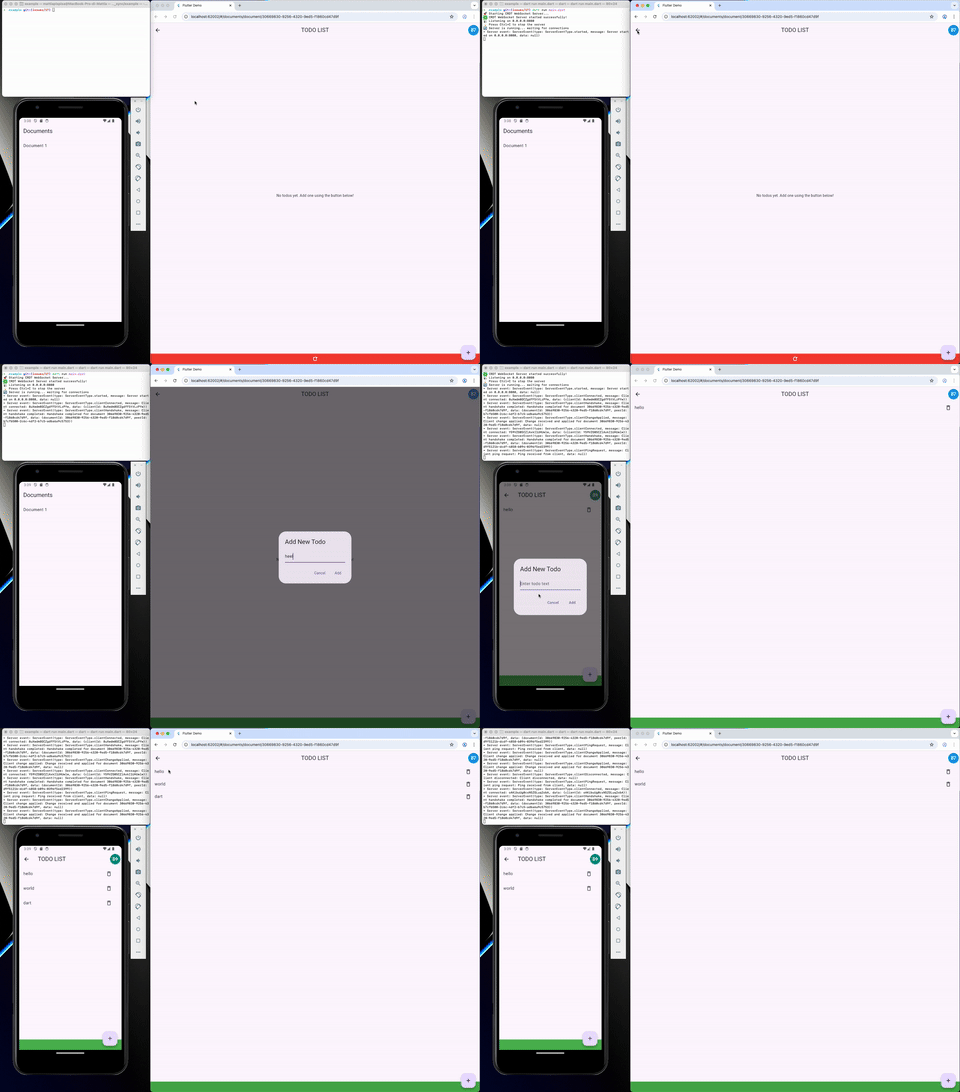
This package provides two examples:
- example/ — a persistent (Hive-backed) WebSocket server for the CRDT-aware server–client mode.
- client_example/ — the Flutter client counterpart, which connects to the server and shows the same examples as
crdt_lf, live over the real backend.
Run the server and a client. The workspace contains a .vscode folder with launch settings to run both server and client.
The server example and the flutter example already use the awareness plugin.
For a full relay mode application (relay client from this library + a Cloudflare Worker relay server), see the greyhound_markdown app.
Apps
- greyhound_markdown — Real-time collaborative markdown editor built on crdt_lf
Packages
Other bricks of the crdt "system" are: